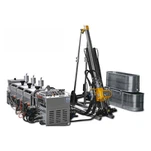
Core drills play an indispensable role in modern geological exploration and resource development. As key equipment for obtaining information about underground rock formations, core drills not only directly impact exploration efficiency but also determine the accuracy of data collection, providing crucial support for the energy, mining, and scientific research sectors.
Efficient and Accurate Data Collection Tools
The core value of core drills lies in their ability to efficiently extract underground core samples. Through rotary drilling and a flushing fluid circulation system, the equipment maintains stable operation under diverse geological conditions, ensuring the integrity and representativeness of the core. Compared to traditional percussive drilling, modern core drills utilize hydraulic or electric drives, coupled with intelligent control systems, significantly increasing drilling speed and depth while reducing the need for manual intervention. This efficiency makes them the tool of choice for deep resource exploration.
Versatility in Multiple Applications
The application scope of core drills extends far beyond the energy industry. In geological hazard assessments, core drills can help analyze fault and rock structure. In construction engineering, the stratigraphic data they provide directly influences foundation design. In scientific research, high-precision core samples are crucial for reconstructing ancient climates and plate tectonics. Some advanced models also support multi-caliber drilling, flexibly adapting to varying requirements from shallow soil to deep bedrock, further broadening their application scenarios.
Technological innovation drives industry upgrades
In recent years, core drill rig technology has continued to evolve. The introduction of automated control systems reduces human error, while modular designs lower maintenance costs. Some equipment now incorporates real-time data transmission, allowing engineers to remotely monitor drilling parameters and adjust strategies instantly. These innovations not only improve operational safety but also promote the adoption of green exploration concepts-for example, by optimizing flushing fluid circulation to reduce environmental pollution.
As global resource development expands into complex geological environments, the value of core drills will become even more prominent. Whether ensuring energy security or supporting sustainable development, these drills remain a crucial bridge between the surface and the subsurface.