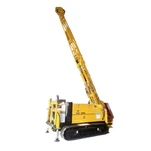
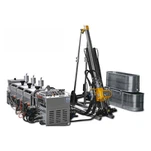
Core drills are essential equipment in geological exploration and resource development. Their core function is to obtain core samples, helping engineers and geologists analyze subsurface structures, mineral resource distribution, and geological conditions. With growing global demand for energy and minerals, core drilling technology is constantly evolving to adapt to increasingly complex exploration environments.
The primary operating principle of a core drill is to use a rotating drill bit or percussion drilling to break up rock and extract a continuous core sample. This method provides more precise characterization of the physical and chemical properties of subsurface rock than other drilling techniques, such as percussion drilling or auger drilling. The integrity of core samples is crucial for subsequent laboratory analysis, so selecting the appropriate drilling method and drill bit type is crucial to successful exploration.
Currently, core drills are primarily categorized into diamond drills and carbide drills. Diamond drills are suitable for drilling hard rock, and their high wear resistance enables efficient operation even at depth. Carbide drills, on the other hand, are more suitable for soft rock or loose formations, offering lower costs and greater operational flexibility. Furthermore, modern core drills are equipped with automated control systems that monitor drilling parameters such as bit pressure, rotational speed, and penetration rate in real time, thereby optimizing drilling efficiency and reducing equipment wear and tear.
Globally, core drills are widely used in oil, natural gas, metal minerals, and hydrogeological exploration. For example, in deepwater oil and gas exploration, drills must withstand high pressure and corrosion to withstand extreme environments. In mining development, core drills are used to determine ore boundaries and grade distribution, providing data support for subsequent extraction.
With technological advances, core drills are becoming more intelligent, environmentally friendly, and efficient. For example, some newer drills utilize electric drive systems, reducing carbon emissions while improving energy efficiency. Furthermore, the application of artificial intelligence and big data analytics is making the drilling process more precise and controllable.
The development of core drill technology has not only promoted the advancement of geological exploration but also provided reliable support for global resource development. In the future, with the introduction of new materials and new technologies, core drilling rigs will play an important role in a wider range of fields.