Drill tools are core tools in modern industry and energy extraction, and their operating principles directly impact project efficiency and safety. Whether in oil drilling, geological exploration, or construction projects, drill tools play an indispensable role. Understanding their working principles will help you better select and apply this critical equipment.
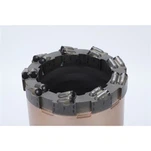
The basic structure of a drill tool typically consists of a drill bit, drill rod, stabilizer, and power transmission system. The drill bit is the part that directly contacts the formation or workpiece, responsible for breaking rock or material. Depending on the operational requirements, drill bits can be categorized as roller bits, PDC (polycrystalline diamond compact) bits, and percussion bits. Roller bits are suitable for hard formations, achieving efficient rock breaking through rolling cutting. PDC bits, leveraging the high hardness of diamond, excel in soft to medium-hard formations. Percussion bits use periodic impact force to break hard rock.
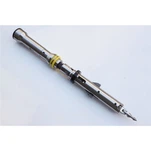
The drill rod is the transmission component connecting the drill bit to surface equipment, responsible for transmitting torque and axial pressure. Modern drill rods are often manufactured from high-strength alloy steel to ensure stability under high-pressure and high-temperature environments. Stabilizers are installed on the drill pipe to maintain verticality in the borehole, prevent drilling tool deflection, and thus improve operational accuracy.
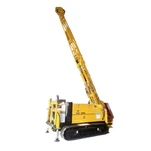
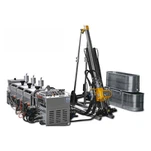
The power transmission system is the core of the drill tool, typically provided by surface equipment (such as a drilling rig) to provide rotational power and axial pressure. Rotational power enables the drill bit to cut the formation, while axial pressure ensures full contact with the formation, improving rock-breaking efficiency. The mud circulation system is also crucial in oil drilling, not only cooling the drill bit but also carrying cuttings back to the surface to prevent borehole blockage.
With technological advancements, automated and intelligent drilling tools are becoming increasingly popular. For example, measurement-while-drilling (MWD) and logging-while-drilling (LWD) technologies enable real-time monitoring of formation data, optimizing drilling parameters, and improving operational efficiency. Furthermore, the use of new materials, such as carbon fiber-reinforced composites, has further enhanced the durability and lightweighting of drill tools.
The operating principles of drill tools determine their critical role in energy development, infrastructure construction, and other fields. Mastering their core technologies not only improves operational efficiency but also reduces operating costs, providing more reliable solutions for modern engineering projects.